
Code Red at OpenAI: Why We Are Currently “Team Gemini”
If you have been scrolling through X (Twitter) this week, you know the vibe has shifted. The headlines are screaming “Code Red” at OpenAI, and for the first time in years, the industry leader looks like it is scrambling.
According to reports, OpenAI CEO Sam Altman has declared an internal “Code Red” to accelerate the release of GPT-5.2, with rumours pointing to a launch as early as Tuesday, December 9th.
Why the panic? Because for the last few weeks, Google’s Gemini 3.0 has been winning.
Here at AI Spark, we don’t trade in rumours; we trade in results.
We have been testing the Gemini subscription exclusively since the big November updates, and the verdict is clear: Google has already delivered what OpenAI is still promising.
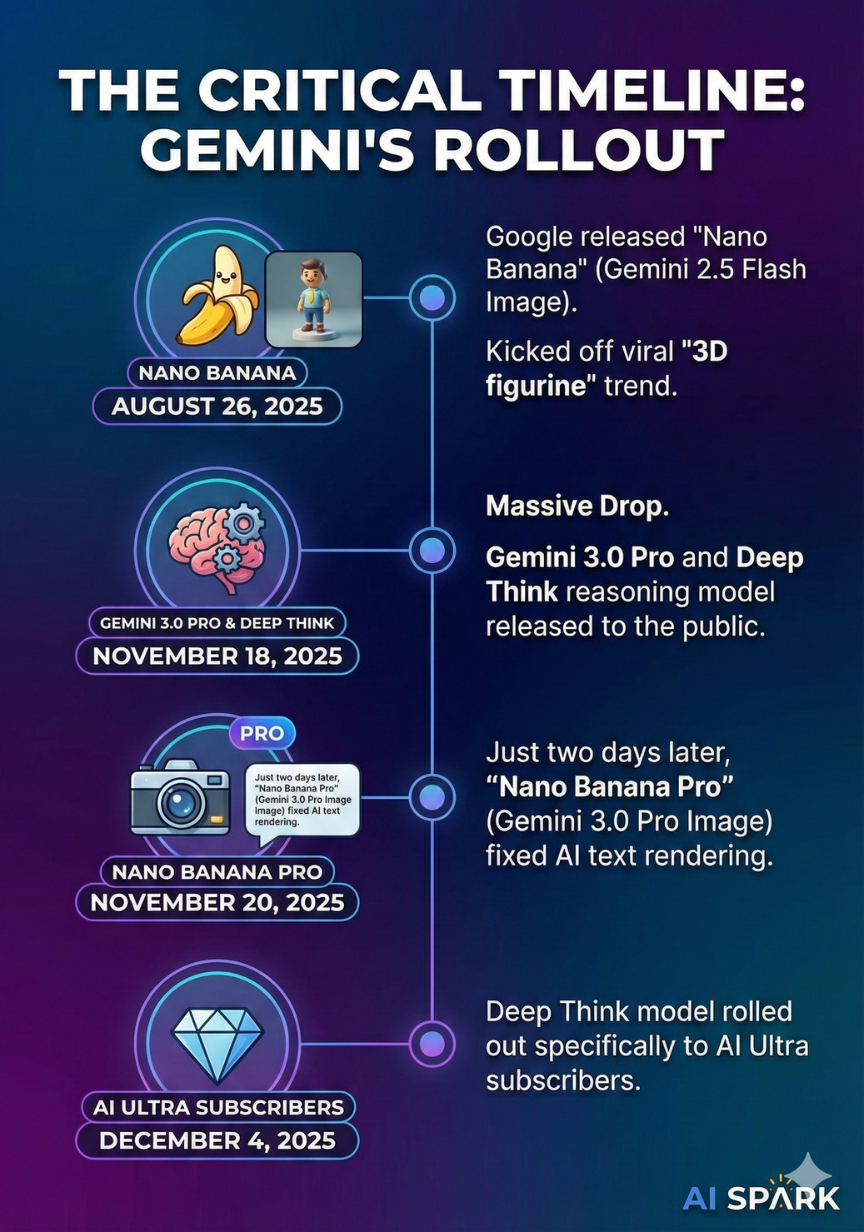
The Critical Timeline: What Actually Happened
To understand why OpenAI is panicking, you have to look at the dates. Google didn’t just release one thing; they executed a perfect rollout strategy while the competition was quiet.
-
August 26, 2025: Google released “Nano Banana” (Gemini 2.5 Flash Image). This kicked off the viral “3D figurine” trend you saw all over Instagram.
-
November 18, 2025: The massive drop. Gemini 3.0 Pro and the Deep Think reasoning model were released to the public.
-
November 20, 2025: Just two days later, we got “Nano Banana Pro” (Gemini 3.0 Pro Image), which fixed the biggest issue in AI art: text rendering.
-
December 4, 2025: The Deep Think model began rolling out specifically to AI Ultra subscribers (like us).
Share This Post
1. The “Nano Banana” Update: Visuals That Finally Work
You might know it by its viral code name “Nano Banana Pro,” but technically this is Gemini 3.0 Pro Image.
For years, we’ve struggled with AI image generators that couldn’t spell. We’d get a beautiful cafe sign that said “C0fffeee.” But since the November 20th, 2025 update, Gemini has solved this.
This isn’t just about the “3D caricature” trend; it’s about workflow.
We can now generate social media headers, presentation slides, and brand mockups where the text is crisp, legible, and accurate – all without needing to open Photoshop.
Share This Post
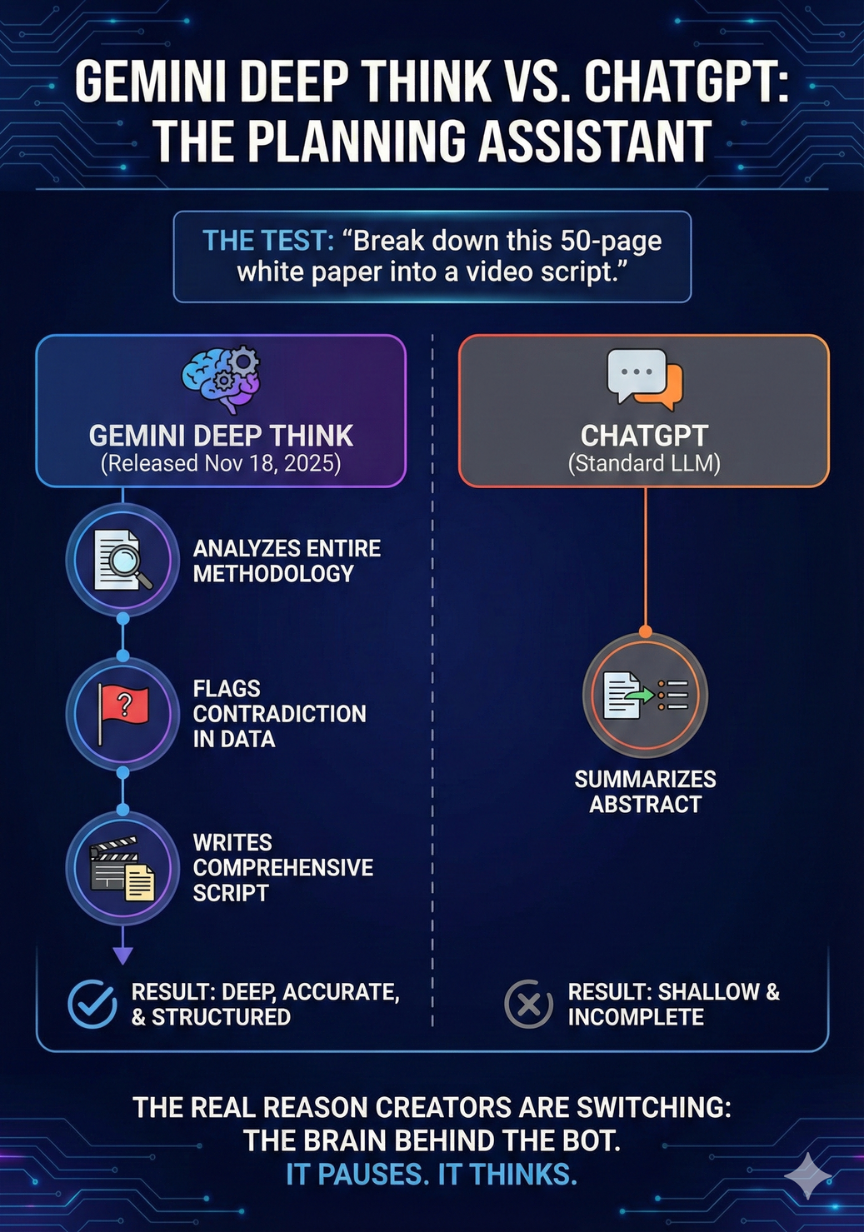
2. “Deep Think”: The Assistant That Plans
The real reason creators are switching, however, is the brain behind the bot.
Google’s Gemini Deep Think model (released November 18th, 2025) operates differently than standard LLMs. Instead of rushing to an answer, it pauses. It “thinks.”
We tested this against ChatGPT on a complex task: “Break down this 50-page white paper into a video script.”
-
ChatGPT: Summarized the abstract (too shallow).
-
Gemini Deep Think: Analysed the entire methodology, flagged a contradiction in the data, and then wrote the script.
Sign up to our newsletter- be the first to hear about AI news:
3. The Community Verdict
We aren’t the only ones noticing. A quick look at X shows a massive sentiment shift. Users are calling out that OpenAI’s potential December 9th release of GPT-5.2 feels like a “panic ship” to stop the bleeding.
One verified user noted that Gemini 3.0 feels like the first time Google actually tried to win, specifically praising the flawless text generation. Tech analysts are even saying that OpenAI declaring “Code Red” is the biggest compliment Google could get.
The Verdict: Why We Are Staying Put
The race is incredibly exciting to watch. If OpenAI releases GPT-5.2 on December 9th, we will test it immediately.
But right now, Gemini is the clear winner.
We aren’t waiting for a “Code Red” fix; we are using a tool that works today. Between the flawless text-to-image capabilities released in late November and the superior reasoning engine, the Gemini subscription is currently the best investment for any serious creator.